Unified customer profiles
At the core of Axiom sits a CDP — Customer Data Platform. It brings website activity, purchases, bookings, email engagement, and social signals into one complete customer profile. See what each customer did, where they came from, what they care about, and whether you can legally contact them.
Your customer base is scattered — and that makes it nearly useless
The same customer lives in ten places at once: the POS knows purchases, the site knows clicks, ads know impressions, email knows opens, chat knows the conversation, and half of it sits in someone's head and a spreadsheet. No single place has the whole person — each tool knows its piece and decides blind.
One customer — seven fragments that do not know each other.
The same data, stitched into one person. Now you see who they are, what they need, and what to do.
It gathers every fragment into a single source of truth
The CDP does four things — and every other Axiom product runs on them.
Merges everyone into one profile
Anonymous visitors, customers, and leads become one profile — merged across devices and channels, no duplicates.
Segments by real behavior
Group customers by behavior, purchase history, and lifecycle. Segments are live: a customer shifts and is instantly in another group.
Tracks consent and preferences
Every profile carries consent status and communication preferences — so you always know who you can legally contact.
Powers every Axiom product
Email, social insights, forecasts, bookings, and consent all run from the same customer data.
The old way vs. the CDP way
Same customer data. Completely different amount of work to make it useful.
The old way
- Customer data lives in the POS, the site, ads, and a spreadsheet someone half-updates
- No single view of who anyone actually is — just fragments that don't talk to each other
- Every tool makes its own guess about the customer, so email, ads, and support all disagree
- Someone manually exports a list, cleans it up, and re-imports it every time a campaign needs a segment
- By the time the spreadsheet is current, it's already out of date
With the CDP
- One profile per customer, built automatically from every connected source
- Identity stitching merges anonymous visits, POS orders, and social accounts into one person
- Every other Axiom product — email, social, forecasts, bookings, consent — reads the same profile
- Segments update themselves as behavior changes, no export/import between tools
- One place to see, and one place to fix, instead of five
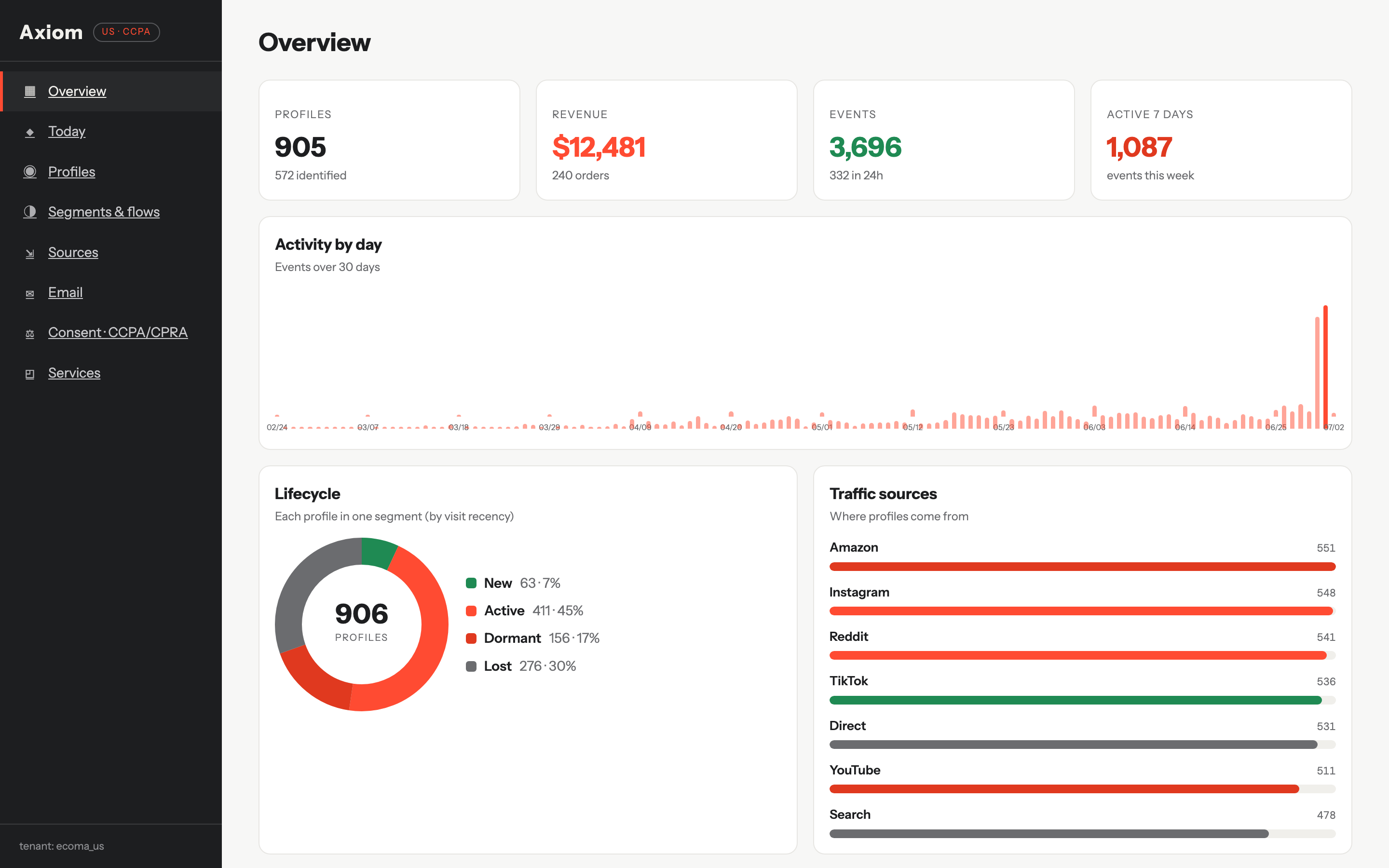
One console — the whole base at a glance
Not a mockup: customer profiles, segments, and events in the live Axiom console.
Without the core, the other products run blind
Email, social, forecasts, and bookings are only as strong as how well they know the customer. They all read from one CDP — so every product speaks to that person consistently, not like five strangers guessing.
All five read the same CDP profile. One customer, one story.
From scattered touches to one profile
Events
Visits, orders, sources, actions — from every channel into one store.
Identity
Anonymous visitors and accounts converge into one person.
Groups
By behavior and lifecycle, updating themselves.
Products
Email, social, forecasts — on one ready base.
The base is yours — compliant and under control
A unified base does not mean handing data to a third party. The profile stays yours — legally and technically.
Yours, not the marketplace
Contacts and purchase history belong to you. Leave the platform — the base stays.
Consent built in
Every profile carries CCPA/CPRA consent status — products send only to those who allowed it.
Export, no lock-in
Export the whole base in one action; right to delete (DSAR) is built in.
Questions we get about the CDP
Do we need to migrate our existing data in, or does it just build up from what's already connected?
Nothing to migrate on day one. Connect your sources — POS, site, email, social, chat — and the CDP starts stitching profiles from events as they happen. If you have historical order or contact data sitting in a spreadsheet or export, we can load that in too, but it's not a requirement to get started.
What sources can it actually ingest?
Today: POS transactions, site events, social accounts, email engagement, and chat conversations. Each new source you connect adds another layer to the same profile — it doesn't create a separate database. If there's a tool you rely on that isn't on that list, ask us; we're adding sources based on what customers actually connect.
Is this meant to replace our CRM, or sit alongside it?
Alongside it, for most businesses. The CDP's job is to unify behavioral and transactional data into one profile and feed that to email, social, forecasts, bookings, and consent. If your CRM is where sales reps track deals and conversations, keep it — the CDP just makes sure the data feeding your marketing and ops tools is accurate and current.
How is this different from a full enterprise CDP like Segment or mParticle?
Those are infrastructure — powerful, but built for teams with engineers to configure schemas, write transformations, and maintain pipelines. Axiom's CDP is built to work out of the box for a small or mid-sized business: connect a source, get a unified profile, and have every other Axiom product read from it immediately. No data engineer required.
What happens if we stop using Axiom — do we get our data back?
Yes. Export your whole base in one action, in a portable format, any time. The profile is yours — leaving the platform doesn't mean losing your customer history. Deletion requests (DSAR) are also built in if you need to remove a profile entirely.
Turn scattered customer data into repeat revenue
We'll show you, using your own data, how the fragments become one profile — and where to start.